Skip to content
Independent editorial — no affiliate links, no prices, no sponsored placements
SmartHomeVerdict
Robot Vacuums

Small Apartment Cleaning Setup: What Fits and What Is a Waste of Space

In a small apartment, every cleaning tool competes for the same scarce resource — floor and cupboard space. That changes which features are worth paying for.

Dock footprint, storage, cord-free compromises and the two-tool setup that actually makes sense under 700 square feet.

Last reviewed September 2026

What actually goes wrong in this situation

1The dock is often bigger than the benefit it delivers

An all-in-one dock with a water tank occupies roughly the footprint of a small side table, and it needs a power socket plus some clearance. In a studio or one-bedroom flat, that is a real cost — sometimes the difference between a robot you keep and one you give away. If the dock cannot live somewhere sensible, the automation is theoretical.

2Hard floors and one rug do not need flagship suction

Most of the suction headroom in premium models is aimed at deep-pile carpet that small apartments rarely have. Spending for 35,000 Pa on a hard-floor flat buys a heavier, larger machine with a bigger dock and no visible cleaning benefit.

3Storage is the constraint nobody plans for

Roughly 4-inch tall robots, folding mops, charging stands and spare filters all need somewhere to live. Tools that cannot be stored near where they are used do not get used, which is why a hand vacuum that lives on a wall near the kitchen is often more valuable than a better one that lives in a cupboard.

4Small floors mean short cleaning times, and battery life stops mattering

A 600 sq ft apartment is finished long before the battery on any current model runs out. Runtime — a headline figure for house buyers — is largely irrelevant here. What matters is whether the robot gets to the corners and the edges where small rooms accumulate debris.

The specifications that matter here

In this situation, most of the specification sheet is noise. These are the parameters that change the outcome, and what to look for on each.

ParameterWhat it meansWhat to look for
Dock footprint and clearanceAn all-in-one dock is a piece of furniture in its own right and needs power, clearance and, for refill models, water access or regular tank filling.Measure the space before choosing. Tucked beside a washing machine or at the end of a kitchen run usually works.
Height and edge reachSmall rooms have proportionally more edge and furniture per square metre, so the side brush and edge behaviour matter more than raw suction.An extending side brush and edge mopping if the budget allows — both sit in the flagship tier. In a small flat, a light handheld stored within reach often handles skirting, sills and edges better than paying for the feature on a robot.
Suction tierMid-tier suction is ample for hard floors and low-pile rugs. The premium tier buys carpet performance you probably do not have.Anything in the mid range with a rubber brush and decent navigation.
Noise for shared wallsIn an apartment, the loudest part of a robot is often the dock doing its self-clean cycle, not the robot cleaning.Schedule dock cycles for daytime hours, and check the published noise figure.
A second tool for above the floorRobots clean floors only. Sills, window tracks, under-cushion gaps and shelving need a handheld, and in a small flat those jobs are more visible.An ultralight handheld with a wall mount, stored where you actually use it.

Our recommendations for this situation

Pick 1Best for apartments
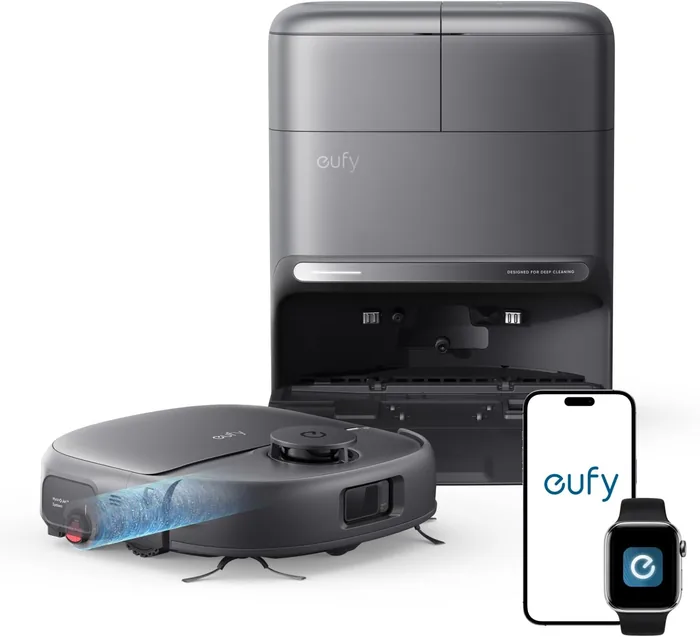
eufy C28 robot vacuum

eufy C28

8.7 / 10Editorial score 8.7 out of 10

The best fit for a hard-floor flat that wants the chores taken off it. 15,000 Pa is mid-tier, which is more than a hard floor needs, and the station does the work that otherwise makes people stop using a robot: it auto-empties into a 3 L bag rated for about 75 days, washes the roller mop and hot-air dries it at 50 °C so it does not turn into a smell source. The 28 cm HydroJet roller rinses itself roughly nine times a second instead of smearing one dirty pad around the flat, and the DuoSpiral brush is rated for hair up to 30 cm. Navigation uses no cameras at all — a smaller thing to worry about, and in a small space the robot is always nearby.

Where it falls short: Height is not published, so measure your lowest furniture before buying — a small flat has proportionally more of it. Obstacle avoidance is proximity-based rather than camera-based, and the listing states no runtime figure.
Pick 2Best budget
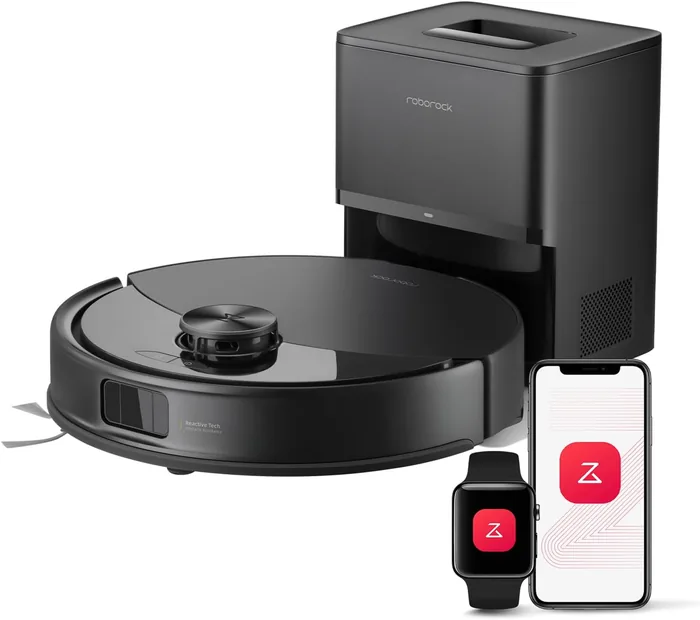
Roborock Q10 S5+ robot vacuum

Roborock Q10 S5+

8.2 / 10Editorial score 8.2 out of 10

The value route into the same hands-off loop. The standout feature at this price is the self-emptying station with a 2.7 L bag rated for up to 70 days — flagship-class automation for an entry-level outlay, and the one feature most likely to keep a robot running in month six. Both collection points are addressed against hair, with a JawScrapers comb main brush plus a dedicated anti-tangle side brush. Mopping is a sonic plate scrubbing up to 3,000 times a minute, and ultrasonic detection lifts it when it crosses onto carpet.

Where it falls short: There is no lifting chassis, so a tall door track or a step between rooms can still stop it, and there is no extending side brush or edge mop — baseboard coverage is ordinary. At 10,000 Pa it has the lowest published suction in our comparison: fine on hard floors, not enough for deep pile.

Pick 3Best lightweight
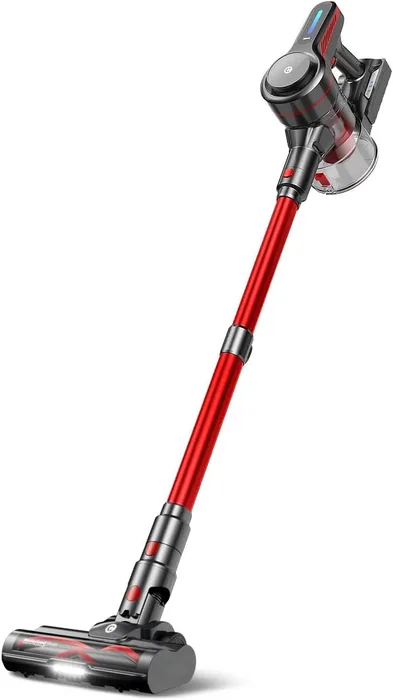
CHEBIO Lightweight Cordless (5 lb) cordless handheld vacuum

CHEBIO Lightweight Cordless (5 lb)

8.2 / 10Editorial score 8.2 out of 10

The second tool, and in a small flat probably the one you reach for most. At five pounds it is the lightest handheld here, it stands up on its own wherever you stop, and its 1.5 L dust cup is unusually large for the weight, so you are not stopping mid-job. It converts to a handheld with a six-in-one accessory set for sills, window tracks, shelving, drawer runners and the gap beside the kitchen units — precisely the work a robot on a 600 sq ft floor never does.

Where it falls short: Its 45 kPa suction claim is not comparable across brands and we would not rank it on that number. There is no dust-reveal lighting, charge time is not published, and CHEBIO has a shorter public reliability record than the established brands here.

Questions about this situation

The follow-ups we get most often once the shortlist is decided.

Do I need a big dock in a small apartment?

No, and often it is a mistake. An all-in-one dock with a water tank takes up roughly the floor area of a small side table, plus power and clearance. In a flat under about 700 sq ft, a compact dock or a robot without water refill is often the more practical choice — what matters is that the dock lives somewhere out of the way, not that it does everything.

What suction do I need for hard floors?

Much less than the marketing suggests. Hard floors and low-pile rugs are easy surfaces; even mid-tier published suction ratings are more than enough, and the difference between mid-tier and flagship is mostly about deep-pile carpet. In an apartment, spend the budget on edge coverage, dock automation and quiet operation instead.

Is a robot vacuum worth it in a studio apartment?

Usually yes, if the apartment has hard floors and the dock has somewhere to live. The benefit is not time saved — you can vacuum a studio in ten minutes — it is that the cleaning happens daily without you deciding to do it. Where it falls down is clutter: a studio has proportionally more furniture per square metre, so obstacle avoidance and edge reach matter more than in a bigger home.

What else should a small apartment have besides a robot vacuum?

One light handheld vacuum with a wall mount, stored within reach of where you use it. Robots clean floors only — sills, window tracks, shelving, drawer runners and the gaps around kitchen units all need something handheld. In a small flat there is less storage, so an ultralight model that can live on a wall beats a larger one that lives in a cupboard.